
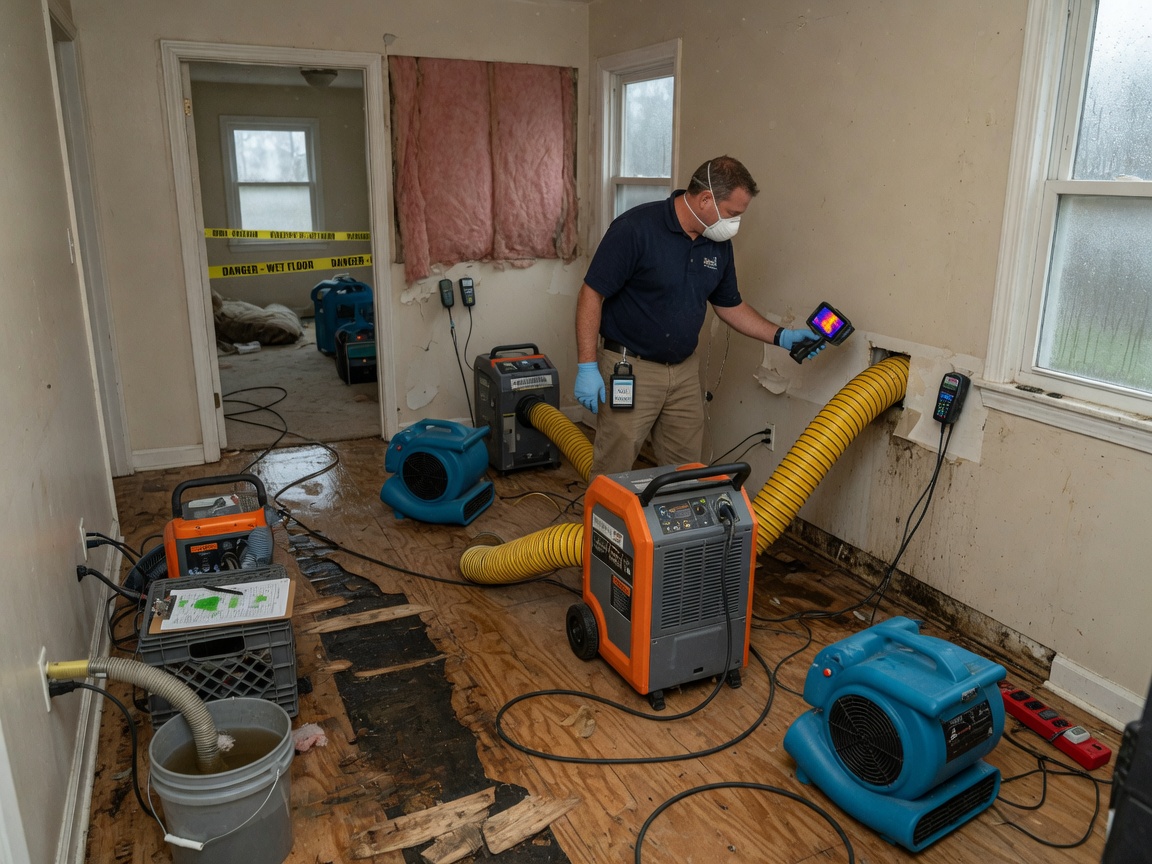
St. Petersburg's humid subtropical climate and frequent tropical storms push moisture deep into older wood-frame and masonry homes common in neighborhoods like Old Northeast and Kenwood. Structural drying requires more than fans; technicians use moisture meters and thermal imaging to locate hidden water in plaster walls, lath, and subfloors before setting up industrial dehumidifiers and air movers sized for the square footage and saturation level. Without proper extraction first, drying equipment simply recirculates damp air and extends the timeline.
Pinellas County homes built before 1970 often have balloon framing and limited access points, so crews must create strategic openings in baseboards or ceilings to reach wall cavities. High groundwater near Tampa Bay means slab leaks or storm surge can wick upward for days, requiring continuous monitoring with data loggers rather than a single visit. Skipping these steps leaves residual moisture that later fuels mold growth behind drywall.
Best Standard Restoration crews stage equipment from the 4604 49th Street N location and rotate it 24 hours a day until readings drop below 1 percent moisture content on affected materials. Daily documentation tracks progress so homeowners and adjusters see exactly when the structure is dry enough for reconstruction to begin.
Technician insight
In St. Petersburg the thing that catches most people out with Structural Drying Services is how quickly high ambient humidity re-saturates older plaster walls once the equipment is pulled too soon; we keep data loggers running until readings hold steady below 12 percent because a single Gulf breeze can push moisture right back into balloon-framed homes near the bay.
Hidden Moisture in Old Northeast Bungalow
After a roof leak during a summer thunderstorm, water traveled along ceiling joists into two bedrooms. Initial extraction left the plaster damp; thermal scans revealed saturation in the wall cavities. We installed cavity drying tubes and ran LGR units for four days until every reading stabilized, allowing the homeowner to start repairs without mold returning.
Structural Drying Services Services We Offer
✓Moisture Mapping and Assessment
Technicians use pin and pinless meters plus infrared cameras to document saturation levels in walls, floors, and ceilings throughout St. Petersburg homes before drying begins.
✓Industrial Dehumidification Setup
High-capacity LGR dehumidifiers sized for local humidity loads pull moisture from the air while protecting hardwood floors and plaster common in older Pinellas County properties.
✓Air Mover and Circulation Placement
Directed airflow patterns move moist air out of wall cavities and under cabinets, preventing stagnant pockets that standard box fans miss in tight Gulfport and South Pasadena layouts.
✓Wall Cavity and Insulation Drying
Strategic baseboard removal and cavity drying with perforated tubing extracts water from fiberglass or cellulose without full demolition in many St. Petersburg residences.
✓Hardwood Floor Drying Systems
Specialized mats and negative-pressure systems dry tongue-and-groove floors from below, avoiding cupping that humidity spikes after summer storms can cause.
Structural Drying Services Cost in Petersburg, FL
| Service | Typical Range | What Affects It |
|---|---|---|
| Initial moisture mapping and equipment setup | $450–$900 | Varies with number of rooms and access difficulty in older homes |
| Daily equipment rental and monitoring | $250–$550 | Based on dehumidifier count and storm-related humidity load |
| Wall cavity drying add-on | $300–$700 | Required when water travels behind plaster or drywall |
Ranges are typical for Petersburg, FL and confirmed with an exact written quote before any work starts.
How it works
- 1
Initial Inspection and Moisture Readings
Crew arrives within hours, maps all affected materials, and records baseline readings in every room and cavity.
- 2
Water Extraction
Standing water is removed first with extraction tools to prevent further wicking into subfloors and framing.
- 3
Equipment Placement and Monitoring
Dehumidifiers and air movers are positioned, then checked daily with updated moisture logs until dry standards are met.
- 4
Final Verification and Handover
Post-drying readings confirm safe levels; equipment is removed and the structure is cleared for repairs.
Pricing
Pricing depends on square footage affected, depth of saturation, and number of days equipment must run.