
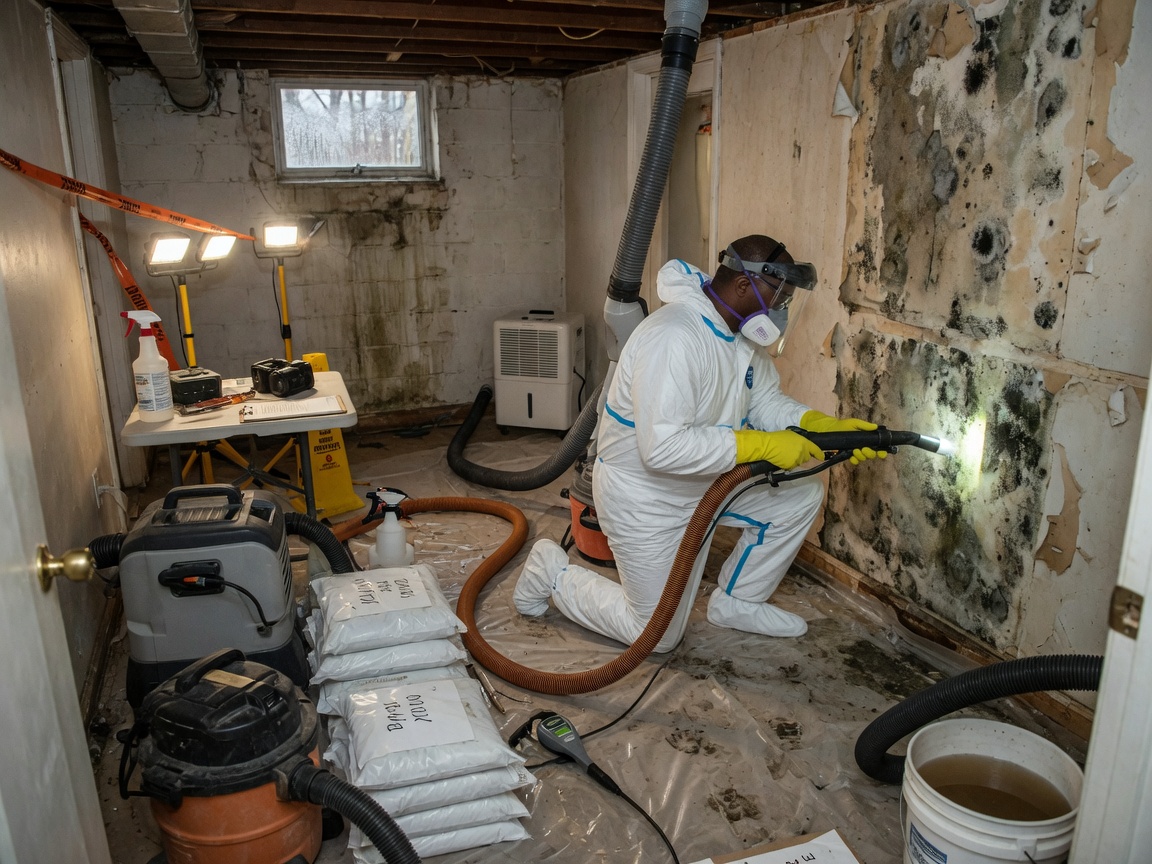
St. Petersburg's humid subtropical climate and frequent Gulf storms push moisture into crawl spaces and wall cavities of 1950s-1970s concrete-block homes common in Old Northeast and Kenwood. Once drywall or insulation stays wet longer than 48 hours, mold colonies establish fast behind baseboards and under flooring. Remediation crews must separate affected materials from the rest of the structure without spreading spores into living areas, especially in tight layouts where HVAC returns pull air from those hidden spots.
Pinellas County building practices often left minimal vapor barriers in slab-on-grade homes near Mirror Lake and downtown, so groundwater vapor migrates upward after heavy rains. Technicians test moisture levels in framing and subfloors with meters rather than relying on visible signs alone. When mold has penetrated textured ceilings or textured plaster common in mid-century bungalows, full removal of the finish layer is required before any new material can be installed to meet current code expectations for indoor air quality.
Post-storm jobs in areas like Gulfport and South Pasadena frequently involve secondary mold after initial water extraction. Crews set up negative air machines with HEPA filtration and seal off rooms using 6-mil poly sheeting taped at seams. All porous materials that cannot be thoroughly dried and cleaned are bagged on-site and removed to prevent re-growth once humidity climbs again during summer months.
Technician insight
In St. Petersburg the thing that catches most people out with Mold Remediation is how quickly humidity re-wets framing in 1960s concrete-block homes after the initial drying fans are removed; if you skip the vapor barrier step on the slab edge the mold returns within weeks.
Kenwood Bungalow After Roof Leak
Heavy rain pooled behind a clogged gutter on a 1962 Kenwood home and soaked the master bedroom wall. Inspection found mold behind baseboards and into the subfloor. Crews contained the room, removed the lower four feet of drywall, treated the framing, and ran dehumidifiers for four days until readings stabilized. Clearance testing passed and the owners rebuilt without recurrence during the next wet season.
Mold Remediation Services We Offer
✓Black Mold Removal
Containment and removal of Stachybotrys in water-soaked drywall and insulation common after roof leaks in St. Petersburg homes.
✓Attic Mold Remediation
Treatment of mold colonies on rafters and sheathing driven by poor ventilation and storm-driven rain in older Pinellas County attics.
✓Post-Flood Mold Treatment
Full remediation after storm surge or heavy rain events that saturate slab foundations in low-lying neighborhoods near the bay.
✓HVAC Mold Remediation
Cleaning and sanitizing ductwork and coils where condensation and high ambient humidity allow mold to grow in central air systems.
✓Drywall Mold Removal
Cutting out and replacing affected drywall while maintaining negative pressure to protect unaffected rooms in tight St. Pete bungalows.
Mold Remediation Cost in Petersburg, FL
| Service | Typical Range | What Affects It |
|---|---|---|
| Small Contained Area | $400–$900 | Single room under 100 sq ft with surface growth only |
| Medium Job | $1,200–$2,800 | Multiple rooms or attic with HVAC involvement |
| Post-Storm Full Home | $3,500–$7,500 | Widespread saturation after flooding in slab homes |
Ranges are typical for Petersburg, FL and confirmed with an exact written quote before any work starts.
How it works
- 1
Inspection and Moisture Mapping
Technicians use meters and thermal imaging to locate hidden moisture in walls, floors, and ceilings throughout the affected St. Petersburg property.
- 2
Containment Setup
Plastic barriers and negative air machines isolate the work zone to prevent spore migration into clean areas of the home.
- 3
Material Removal and Cleaning
Porous materials are removed, surfaces are HEPA vacuumed and treated with EPA-registered antimicrobials, then dried with air movers and dehumidifiers.
- 4
Final Clearance Testing
Independent air sampling confirms spore levels have returned to normal before barriers come down and reconstruction begins.
Pricing
Cost depends on square footage affected, depth of penetration into structural materials, and whether HVAC cleaning is required.